Dawit T. Filmon, Jan Jaenecke, Martin Winkler, Vincent Fourmond, Christophe Léger, and Nicolas Plumeré. Proc. Natl. Acad. Sc. (2025) doi: 10.1073/pnas.2514698122
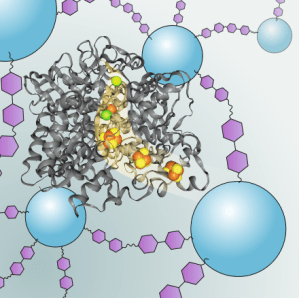
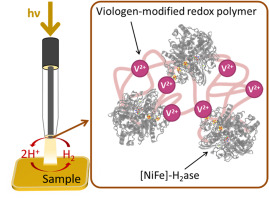
Hydrogenases are Nature’s sustainable and efficient catalysts for the conversion between H+ and H2. The obstacles that prevented their use as H2 oxidation catalysts in fuel cells are being removed one by one, thanks to the continuous discovery of hydrogenases that have unexpected catalytic properties, the development of new methods for their scalable production and matrices that protect them. Obtaining an efficient biohybrid electrode that is scalable and robust under a large range of experimental conditions is still challenging. The FeFe hydrogenase of Clostridium beijerinckii is a very active catalyst of H2 evolution and can be handled under O2, and its production can potentially be scaled up. However, it was believed that it cannot be used for H2 oxidation, as it is easily oxidized to an O2-stable but inactive state. Here, we show that when the enzyme is embedded into a redox-active film whose reduction potential is finely tuned to the equilibrium potential of the H+/H2 couple, the potential that the enzyme experiences can be buffered in a sharp window that is actually compatible with enzyme-catalyzed H2 oxidation and prevents anaerobic inactivation. This leads us to provide the demonstration of an FeFe hydrogenase-based system that can be used for H2 oxidation and that can be repeatedly exposed to O2 during and between operational cycles.
 Redox Shields