Protection of O2 sensitive catalysts under reductive conditions (project 2021-2024)
The implementation of energy conversion schemes involving dihydrogen and CO2 requires solutions that prevent the inactivation by oxygen of biological or synthetic catalysts that are based on cheap and abundant transition metals. The partners of the project have recently developed a strategy for using O2-sensitive catalysts of H2 oxidation under aerobic conditions, which consists in embedding the catalyst into a carefully designed micrometer-thick redox-polymer film supported into an electrode. They showed that self-protection occurs because in addition to catalytic hydrogen oxidation near the electrode, a fraction of the incoming H2 is catalytically oxidized near the film/solution interface to reduce the O2 molecules that penetrate the film (J. Am. Chem. Soc. 141 16734 2019). Newer results of the partners’ demonstrate that a certain polymer design allows H2 oxidation and production to occur in the same film (Nature Catalysis 4 251 2021). This new result opens the possibility for a distinct protection concept, explored in PROSECCO, which should allow the protection of O2-sensitive catalysts under reductive conditions (e.g. for catalytic H2 evolution or CO2 reduction). This new protection mechanism requires that a fraction of the H2 that is catalytically produced near the electrode is reoxidized near the film/solution interface to eliminate the O2 molecules that attempt to penetrate the film. We will explore this protection strategy in the project, after having screened and optimized polymers and metalloenzymes that transform H2 or CO2, and developed the kinetic models of bidirectional mediated catalysis in thin films in the absence of O2. We will explore the effect of O2 both experimentally and theoretically, using fragile but very efficient biological bidirectional catalysts of H2 production and CO2 reduction. We will use an approach that combines the expertise of the two partners in biochemistry (production and optimization of metalloenzymes), synthetic chemistry (redox polymers and dendrimers), physical chemistry (electrochemical characterization of the redox films) and modelisation (numerical and analytical and resolution of reaction-diffusion systems). We will deliver a very important and general piece of knowledge for the electrochemistry and catalysis scientific communities, which appears to be very timely when one considers the current interest in reversible catalysis (Fourmond et al, Nat. Rev. Chem. in press 2021). We anticipate that the new protection strategy will prove operational for enzymes but also for O2-sensitive synthetic inorganic catalysts of very important reactions in the context of environment and energy.
Hydrogel shields to support and protect catalysts of H2 oxidation and CO2 reduction (project 2015-2018)
The use of metalloenzymes or synthetic inorganic complexes as catalysts in fuels cells or photoelectrochemical cells may open key routes in energy production and in industrial synthesis. However, the intrinsic fragility and oxygen sensitivity of these catalysts has been an obstacle. Hydrogenases, the very efficient but very fragile biological catalysts of H2 oxidation, could be protected from O2 damage upon integration into a specifically designed redox hydrogel, which reduces oxygen at the polymer surface and thus provides self-activated protection from oxygen [Plumeré et al, Nature Chemistry, 2014]. We could also rationalise the protection mechanism and optimise the design of the catalyst-polymer films [Fourmond et al, J. Am. Chem Soc., 2015]. These results have set the stage for the full investigation that is the goal of this ANR/DFG project.
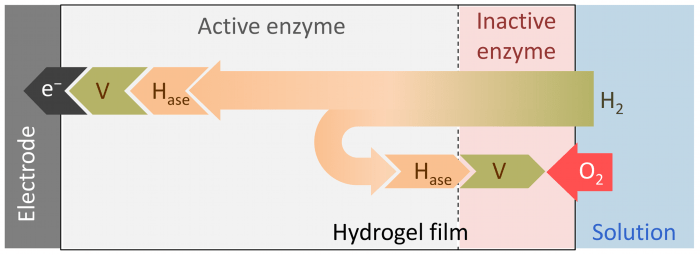
We shall examine a variety of configurations (oxidative or reductive catalysis in thick or thin films), using enzymes such as hydrogenases and CO dehydrogenases as models of fragile catalysts. The enzymes have been selected because they exhibit various properties (reversible or irreversible catalysis, reversible or irreversible inhibition by O2, rates of inactivation and reactivation that can be tuned by protein engineering). Each of these enzymes catalyses, at rates in excess of thousands per seconds, a reaction that is important in the context of energy and environment (oxidation and production of H2, reduction of CO2). Understanding how the hydrogel protects the catalysts requires that the kinetic and geometrical properties of the film be determined, and used in realistic mathematical models that take into account the various chemical reactions and diffusion processes occurring in the depth of the film; the models should then be validated by experimental measurements of how the presence of O2 affects the catalytic current, before the knowledge that has been acquired is used to guide the new design of the film (hydrophobicity of the polymer backbone, redox potential of the redox moieties, thickness, load, etc.).
Our ultimate goal is to fully understand the function of these complex systems where the catalysts is embedded into a protective redox-active hydrogel, to understand the factors governing current density and protection, and become able to rationally design robust catalytic electrodes for actual applications using metalloenzymes or any other efficient but fragile catalyst.
 Redox Shields